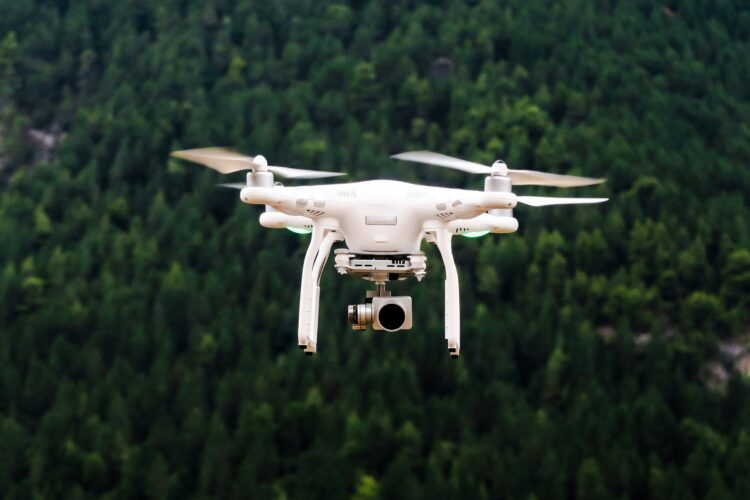
Photo by Jason Mavrommatis
Why not let the industry you’re passionate about potentially help pay for your next drone?
You’ve studied hard for your FAA Part 107 exam. You know the airspace, the regulations, the weather patterns, and the difference between Class B and Class G airspace. You understand how drones fly, where they can operate, and what the commercial drone industry looks like from the ground up. That knowledge is valuable — not just in the cockpit, but potentially in your investment portfolio.
There’s an old investing principle often attributed to legendary fund manager Peter Lynch: invest in what you know. The idea is simple — when you understand an industry deeply, you’re better equipped to recognize which companies have real staying power and which ones are riding a wave of hype. As a drone pilot or aspiring Part 107 operator, you have a front-row seat to one of the fastest-growing technology sectors in the world.
The global drone market is projected to reach $147.8 billion by 2036, up from an estimated $69 billion in 2026. Defense budgets are expanding, delivery applications are scaling up, and commercial UAV use across agriculture, infrastructure inspection, and public safety is accelerating. The tailwinds behind this industry are substantial.
So here’s a thought worth exploring: what if the same industry you’re passionate about could also help fund your next drone purchase? No guarantees, of course — the market is unpredictable, and drone stocks can be volatile. But for pilots who are already tracking this space day-to-day, investing in drone-related companies is at least an informed starting point.
10 Publicly Traded Drone-Related Companies of Interest
Here’s a snapshot of ten publicly traded companies with meaningful drone exposure, ranging from pure-play UAV manufacturers to defense giants and delivery innovators. These companies have shown solid or increasing revenue in recent periods.
- AVAV – Aerovironment – Defense – FY2024 revenue grew 33% YoY to $716.7M; net income turned positive at ~$60M. FY2026 guidance: $1.85–$1.95B.
- KTOS – Krator Defense & Security – Defense – FY2024 revenue grew ~10% to $1.14B; net income of $16.3M after a prior-year loss. Known for its XQ-58A Valkyrie drone.
- ONDS – Ondas Holdings – Industrial/ Defense – Raised 2026 revenue outlook to $170–$180M (+25% over prior target). Q3 2025 revenue jumped 800% YoY to $10M.
- RCAT – Red Cat Holdings – Defense – Solid defense contract wins; expanding facilities in Utah, California, and Georgia. Targeting $80M+ in 2025.
- TXT – Textron Inc. – Defense/Commercial – $15.9B market cap; drone business runs through its Systems division. Deep defense contracts offer steady exposure.
- PLTR – Palantir – Ai/Software – AI systems like Maven Smart System are embedded in Pentagon drone targeting infrastructure. Strong recurring revenue growth.
- BA – Boeing – Defense/Maritime – Developing the MQ-25 uncrewed refueling aircraft and autonomous maritime vehicles. Largest aerospace/defense market cap.
- DPRO – Draganfly – Defense/Commercial – Signed agreements with U.S. Air Force Special Ops. Transitioning toward military contracts representing ~90% of sales. Small-cap, higher risk.
- AMZN – Amazon – Delivery – Prime Air operating in 10 U.S. cities with plans for 50+ globally. Targeting 40% reduction in last-mile delivery costs.
- EH – EHang Holdings – Urban Air Mobility – Pioneering autonomous passenger drones (eVTOL) for urban air mobility and logistics. China-based; international expansion underway.
What Makes Drone Pilots Good at Watching This Space?
As a pilot studying for or holding a Part 107 certificate, you’re already tracking regulatory changes from the FAA, following developments in Remote ID, BVLOS waivers, and UAS traffic management. You likely know when major contracts are awarded, when new platforms are announced, and which companies are winning military or commercial deals. That kind of real-world context is exactly the type of information that helps investors separate signal from noise.
You’ll also recognize names on this list from the industry itself. AeroVironment’s Switchblade and Puma systems are widely deployed. Kratos is known for building affordable, attritable drones — a growing priority in modern defense. And Amazon’s Prime Air is reshaping what commercial drone operations look like at scale.
A Few Things to Keep in Mind
The drone sector spans a wide risk spectrum. Some companies on this list — like Boeing, Textron, Amazon, and Palantir — are massive, diversified organizations where drones are just one segment. Others, like Red Cat, Draganfly, and Ondas, are smaller, earlier-stage companies with bigger upside potential and bigger downside risk. Some are profitable; others are still investing heavily in growth.
Before making any investment, it’s worth researching each company’s financials, understanding how much of their business is actually drone-related, and thinking about your own investment timeline and risk tolerance. ETFs like the ARK Autonomous Technology & Robotics ETF (ARKQ) or the Global X Defense Tech ETF (SHLD) offer a way to get broad drone and defense-tech exposure without picking individual stocks.
And of course — talk to a financial advisor. This article is meant to spark curiosity, not replace professional guidance.
The Bottom Line
The drone industry is no longer a niche hobby market. It’s a multi-billion-dollar ecosystem spanning defense, logistics, agriculture, infrastructure, and urban air mobility — and it’s growing fast. As a drone pilot, you understand this world better than most. Whether you ever invest in these companies or not, keeping an eye on the publicly traded players in this space is a great way to stay connected to where the industry is headed.
And hey — if the stocks rise over time? Maybe that’s how you justify upgrading to your next drone.